
Who Is the ‘Safe City’ Safe For & Six Other Stories from TIA Talk on AI, Gender, and Information Integrity

Updated: 9 hours ago
AI is sold to women as protection, and used against them as a weapon. At TIA Talk, on 19 October 2026, journalist Adrija Bose (Editor, Decode, BOOM) and researcher Disha Verma (Program Manager, Tech Global Institute; Tech+Society Fellow, Ashoka University) traced how these two sides meet.
Disha's investigation into AI-enabled cameras in Lucknow showed a women's safety project that couldn't do what it promised. Adrija's investigation into an AI-generated influencer exposed a business built on a woman's face without her knowledge or consent. Between them, they argued that surveillance and image abuse can't be separated: the cameras meant to keep women safe are often the ones that put them at risk.
Below are the seven stories Adrija and Disha shared during their interaction that show us how AI-based systems built in the name of protecting women are falling short on their promises and how AI is being misused to cause more harm to women.
Two showcases at the end focussed on gendered disinformation (by The Quint) and on intervention to curb the tech stack that allows harmful deepfakes to be created and distributed (by Tattle).
The session, "AI, Gender, and Information Integrity: From Undressing Economies to Surveillance Systems", was powered by BOOM, with our partners The Healthy Indian Project, Newschecker, Tattle and The Quint.
The ‘Safe City’
Shared by Disha Verma
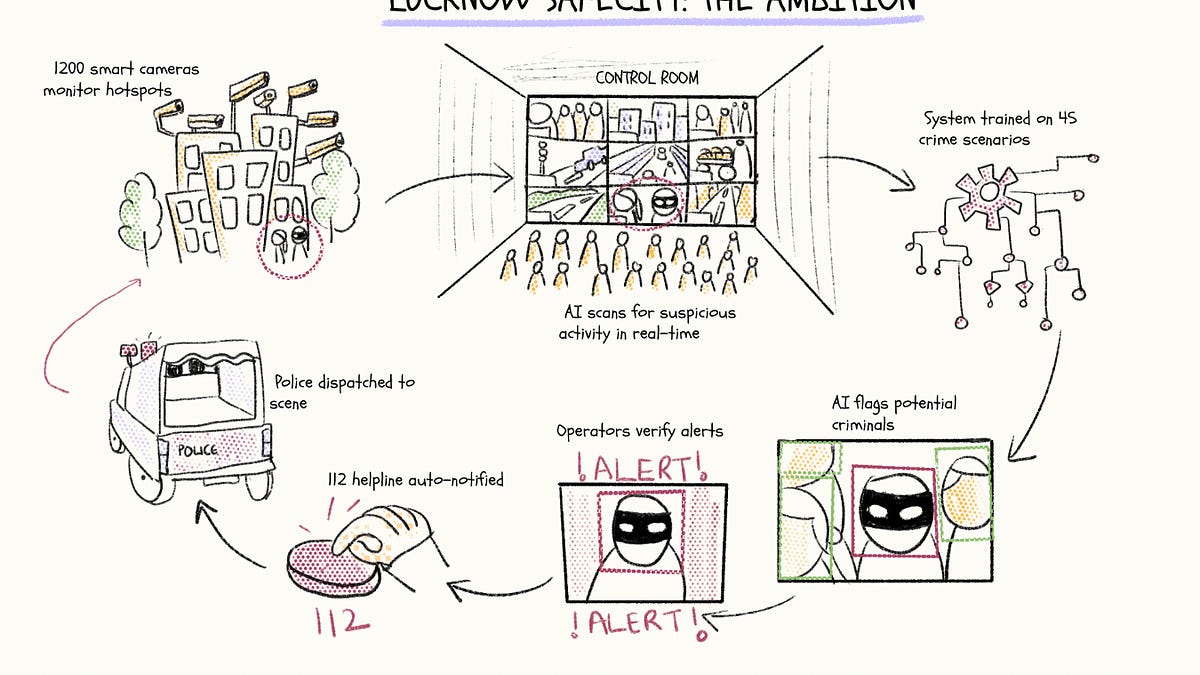
In 2021, the idea of a "safe city" took over India's news cycle. Eight cities were chosen to be made safe for women, each with a budget of around ₹100 crore from the Nirbhaya Fund, which is run jointly by the Ministry of Women and Child Development and the Ministry of Home Affairs. One of them was Lucknow. The city’s surveillance infrastructure got an AI upgrade with AI-enabled surveillance cameras, AI analytics of real-time camera footage and other AI-powered policing tools which were installed across the streets.
Then came the headline that caught Disha's eye: Lucknow would use emotion detection. Cameras would read distress on the faces of women walking the streets. If a woman frowned, the system would alert the nearest police station, and a van of officers would be sent to help. The aim was to stop harassment, acid attacks, teasing, hair pulling and slapping before they happened.
"As a woman, I've never really seen AI as a friend," Disha said. Since generative AI has arrived, she has associated it with deepfakes and more sophisticated tools that allow sexualisation of women at a scale. So for a moment, she thought: maybe this is something that can work.
Two or three years later, at the Internet Freedom Foundation, she looked again. The RTIs her team filed came back blank, and the news coverage had stopped altogether. So she caught a train to Lucknow, walked into the office of the DCP, Crime, and said: "Hey, you don't know me, but as a woman, I want to know what you're doing here." She spent the next week in Safe City control rooms with police officers and engineers.
What she found was that emotion detection had never happened, and never could. "The truth is that that's scientifically not possible. You cannot detect emotions from the faces of people through AI and prevent a crime from happening." Instead, the system flagged "actions": officials told her they knew how a man holds a glass bottle by the neck when it contains acid. And although the system had been running for about two years, it had never been connected to the police. Not one alert had reached an officer.
The cameras were collecting something, though. The system was run by a private vendor, and Disha watched a 10-by-20-foot screen scan faces in real time, tagging women's faces with an age and a number. The engineers told her the data was training their AI, which they planned to sell to private companies once it became accurate enough. India's data protection law exempts government bodies and their partners, so nothing stood in the way. Disha called it "a free-for-all, zero privacy, zero legal restrictions playground".
The money came at a cost. Disha said Safe City is drawing so heavily on the limited Nirbhaya Fund that money is being taken away from women safety initiatives that are grounded in reality such as the one-stop centres, which give women medical and legal aid and shelter after experiencing violence.
"That is being very quickly and very confidently replaced… because it just sounds more modern." Many "tech for good" startups, she added, use the fund to build for women and then apply the technology elsewhere.
One more detail stayed with her. Of the 120 to 150 people she met working on the project that week, not a single one was a woman.
Adrija's takeaway was that a project created as a public response to sexual violence had been turned into a surveillance tool, and that the media had reported it the way police pitched it, "we are watching you, therefore you're safe", for years. Disha put it down to how AI is sold in India: "We find a solution first, which is AI-oriented, and then we look for a problem to apply that to."
1. Misusing neighborhood CCTVs to harass women
Shared by Disha Verma | Anecdote
Disha shared an anecdote about the neighborhood she lives in, which has a Residents' Welfare Association (RWAs) with its own sophisticated CCTV network. When her pet went missing, she went to her RWA secretary and asked if she could check the footage.
He told her they had tightened access. In the last few years, a lot of young boys had come asking for the CCTV password and for footage, for reasons they wouldn't explain. They had used that access to stalk women, harass them, and work out where they lived.
The Internet Freedom Foundation has written about similar cases across Delhi, where CCTV feeds have been used openly to stalk and harass women, because anyone with a password can get in.
And the cameras are everywhere. The Indian state takes pride in being CCTV-forward: after Telangana and Hyderabad, Delhi is the national capital of CCTV cameras.
"AI is just an amplification," she said. "It's supercharging something that we already have a problem with, which is gendered violence."
2. An Influencer Created Using AI But Without The Woman’s Consent
Shared by Adrija Bose

At Decode, Adrija and her colleagues were seeing AI deepfakes and non-consensual images of women all the time. "One of the first use cases of AI probably is - 'Grok, please make this woman wear a bikini,'" she said. That, she said, is the mass scale at which people in India were using AI. So with a Pulitzer Center grant, Decode and Tattle set out to track the supply chain behind it: who builds these tools, and who profits from them.
One story led the way. A content creator from Assam had been posting for five or six years. She wore revealing clothes, had a whole backstory, made brand videos and did collaboration posts. "Nothing to doubt her at all." Small digital media outlets wrote about her as a cool, popular creator from Assam.
Then one day she posted a picture with a US porn star, and after about four years, someone discovered she wasn't real.
Adrija tracked down the man behind the account. He was the woman's ex-boyfriend, and he had used her face to create the videos. The account wasn't popular at first, but the videos got better over time, the account became a huge hit, and he made money from the deepfake content. The reporting ended with his arrest.
But for Adrija, that was where the bigger story began - how deepfake content was being sold and purchased through mainstream payment apps.
4. The Telegram bots that take UPI payments
Shared by Adrija Bose
While investigating the Assam case, Adrija also found Telegram bots that generate this kind of content, all connected to each other. "It is not just that guy who is the main person who is at fault here," she said. There were hundreds of these bots, displaying UPI IDs and accepting UPI payments. That makes banks part of the picture because they could stop those payments.
Adrija reported the accounts to the authorities. Nothing happened. There was no response, and accounts that do get removed often come back. When she checked about a month before October 19 TIA Talk, those were still very much alive and active.
The tools to create these deepfakes aren't hidden, either. Apps that do this are on app stores, including the Google Play Store. "It's not some dark, shady part of the internet. It's very much available out in the world." Adrija said, “My understanding is that because Google allows it, everybody gets a cut of it".
In her investigation into Telegram bots, Adrija found that the victims were largely South Asian women, and from what she learned, certain models were being trained on South Asian women's faces to make the videos more realistic. Which raised the question that frightens her: where do those faces come from? People blame women for posting photos on social media. "But what if there are CCTV cameras outside my house taking pictures of me, and that goes there,” she asks.
5. The Camera Traps In National Parks
Shared by Adrija Bose
Adrija talks about another study on how the footage of AI-enabled cameras installed in some national parks to track wildlife movement was misused to snoop on women of the forests’ village communities.
A researcher from Cambridge University spent a couple of months in Jim Corbett National Park and some other wildlife reserves studying how AI-enabled cameras were being used to protect wildlife.
The forest, though, is also a shared space for the women who live nearby, explained Adrija. They go there to talk. Because they don't have proper washrooms, they bathe there and take off their clothes. They felt free in that space, without knowing the cameras were taking their photos.
The cameras should have been able to tell a woman from a tiger. The AI-enabled cameras photographed the women anyway, and someone with access to the photos made them viral on social media. There were a few news reports, and then everyone moved on. The cameras are still there, still taking pictures. When Adrija went back to speak to some of the women, they told her that now, when they hear the click, they know there is a camera.
For Adrija, the CCTV cameras in the forests and the Telegram bots are part of the same problem. There are government actors who make AI cameras mandatory, and bad actors who misuse what those cameras capture. "We cannot talk individually about them without them being connected to each other,” said Adrija.
5. Why women stay away from protests
Shared by Disha and Adrija
Adrija and Disha discussed what the recent student protests that took place in September-November 2026 in Delhi and in other cities in India, had shown them about surveillance, given how Disha herself faced doxxing.
Disha started with history. Surveillance, she said, comes from the state wanting to define who a criminal is, and it has colonial roots. It has always had a voyeuristic quality, and women have always been watched: to sexualise them, and to police them, because their movement was legally restricted for a long time.
In South Asia, she said, policing and surveillance grew out of watching areas where women did sex work, which offered "the best of both worlds": the pleasure of watching women, and the aim of catching criminals.
Women carry that awareness with them. "I'm constantly looking at my windows," Disha said. "I think the window behind me is open, so I'm very watchful."
Now, she said, marry that with a state that proudly calls itself a surveillance state. The Delhi Police has not been a good actor for a long time, as the 2019 Jamia protests and the legal action against the protesters during the anti-NRC protests showed in 2020.
What worries her more today is that the police increasingly work with private companies that supply the technology and store the data. Delhi Police officers now wear body cams, Meta glasses and other wearables.
"But who is this tech for?" Adrija asked.
For the police first, Disha said, “to collect data and profile people”. During the 2026 students’ protests, there was reporting on faces being extracted and matched to ID cards, possibly to build a list of protesters for a database of suspects.
But mostly, it is a deterrent. Facing an officer wearing five recording devices puts fear in protesters, especially women, who have learned that being watched is not safe. So women wear masks and scarves, walk in groups, or don't go at all, because no one knows what happens to their pictures. They might end up as non-consensual images, as in Adrija's reporting, or sit in storage forever.
Younger people may understand that deepfakes exist. But many parents don't, and the fear of log kya kahenge, what will people say, if a picture ends up somewhere is enough: "My life is gone, it's destroyed. It's just a risk too large to take."
And the consequences can be real. After the farmers' protest in February 2024, many farmers received notices to seize their property or cancel their visas, after being identified as protesters. Women's faces are already being lifted from social media and trolled endlessly on Twitter by right-wing accounts.
"Surveillance creates fear, and that fear is enough," Disha said. "We don't really have to wait for what might happen."
6. Women's safety budgets for riot control
Shared by Adrija Bose

As the conversation closed, Adrija picked up a comment from Jatin in the chat about tenders worth around ₹16 crore. The Internet Freedom Foundation had also reported on them. The purchase was meant for riot control, but it was made under women's safety.
Adrija said this is exactly what Disha had found in Lucknow, now happening in a more centralised way. "You call it women's safety, but you're actually using it for surveillance," she said.
Showcase 1: What gendered disinformation looks like in South Asia
Aishwarya Varma, Assistant Editor (Fact-Check) at The Quint, shared findings from a cross-border study The Quint carried out with organisations from India and Pakistan. Most existing research on gendered disinformation was Western-centric, she said, and missed the region's cultural context. So the partners set out to define the problem for South Asia.
They placed gendered disinformation within gender-based violence, which happens both offline and online. Online, it shows up as character assassination, doxxing, invasion of privacy, and targeted attacks on women, queer and trans people, and religious minorities.
Three findings stood out:
It is intersectional. Attacks were rarely about gender alone. Caste, religion and class shaped who was targeted and how, and women faced criticism that men would not.
Its purpose is silencing. The attacks aimed to push women out of public debate and public spaces. Many of the women the partners spoke to described censoring themselves.
AI has lowered the barrier. Bots and generative tools make abuse easy to produce at scale and in many languages. Algorithms reward the most vitriolic content, and the conversations move into closed WhatsApp and Telegram groups.
To keep their analysis consistent, the partners sorted cases into "definite" gendered disinformation, which was clearly false or fabricated, and "borderline" cases, such as gossip, out-of-context images, or criticism a man would not face. Each organisation's cases were reviewed internally and then by a partner organisation.
In Pakistan, the most prominent attacks targeted the trans community and the annual Aurat March. In India, The Quint studied urban cases against public figures, queer people and minorities. Its case study followed three Muslim women journalists who cover communal violence, hate speech and hate crimes. The abuse they faced was both sexist and communal, and their photos had earlier surfaced on apps that put Muslim women up for "auction".
Aishwarya closed with what the women needed: greater platform accountability, content moderation that works in Indian regional languages, and enforcement of the laws that already exist.
Showcase 2: Interventions across the deepfake stack
Intervention Strategies listed on page-29
Kaustubha Kalidindi of Tattle previewed a new report that grew out of the Assam investigation shared by Adrija. It maps the layers behind a single deepfake, beyond the perpetrator and the victim-survivor, and asks what can be done at each one.
Training data. Women's images become training data without their knowledge. Users can "poison" their images so models can't learn from them, but that is technical and taxing. Removing images from datasets is expensive and hurts model performance, so developers have little incentive to do it.
Models. There is no legal category yet for how models are trained, and safety evaluations are not mandatory in India. Responsible-use licences are hard to enforce on open-source models once they are downloaded or fine-tuned.
Hosting platforms. When repositories are taken down from platforms like GitHub or Hugging Face, copies already downloaded keep circulating.
Apps and bots. Takedowns are the usual tool. But blanket bans also restrict internet access and free expression, so they need to be proportionate.
Money. Deepfakes are monetised through UPI payments and ads. Payment services and regulators could block these transactions if victims could report them, the way suspicious transactions are reported.
Kaustubha said support workers see enforcement, more than missing laws, as the biggest gap. That means being able to file an FIR without being ridiculed, and getting platforms to act before content goes viral. "A lot of the harms that women experience is from being watched," she said. "There's always somebody ready to misuse you, your words, your likeness."
Why these stories are about information integrity
At first glance, a camera in a Lucknow street and a deepfake influencer in Assam look like separate problems. But each of these stories turns on information that misleads, and women pay the price.
Some of it is a false promise. Lucknow's Safe City was sold as AI that could read distress on women's faces, and the media repeated that claim for years while the system did nothing of the kind. Women's safety budgets paying for riot-control equipment are the same story in another form. When technology is described as something it isn't, the public can't hold it to account, and the money meant for women goes elsewhere.
Some of it is fabricated content. The Assam creator was a deepfake that digital outlets profiled as a real woman for years. The Telegram bots and Play Store apps produce such content at scale, for a fee. The Quint's research shows how this content works as gendered disinformation: it is built to shame women and push them out of public life.
And surveillance feeds all of it. The faces collected by city cameras, RWA networks, forest camera traps and police wearables are the raw material for deepfakes and trolling. The fear of where those images might end up is enough to keep women off the internet and away from protests. That fear is the silencing The Quint's study found.
This is where Tattle's work comes in. Its map of the deepfake stack shows where the stories above could have been stopped. Images taken without consent, like those from the camera traps and CCTV feeds, are a training-data problem. The Telegram bots taking UPI payments are a money problem that payment services and regulators could act on. The apps on the Play Store are an app-layer problem for platforms. The reports Adrija filed that went nowhere point to the gap Kaustubha named: enforcement.
These interventions are part of the answer, not all of it. They address deepfakes and image abuse. They do not stop states from buying surveillance in the name of women's safety. That calls for transparency about what AI systems can really do, scrutiny of how women's safety funds are spent, and reporting that tests the claims made for new technology instead of repeating them. That, too, is information integrity.
Speakers:
Adrija Bose
Editor, Decode
Decode, BOOM
Disha Verma
Asia Programs Lead, Tech Global Institute; Tech Society Fellow, Ashoka University
Tech Global Institute


Comments